
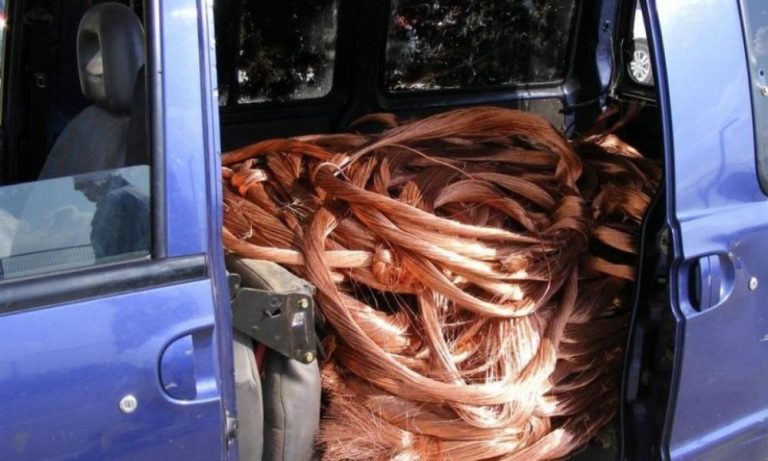
The theft of copper and other metals from industrial sites has become a real concern for many companies. We are not only talking about the value of the stolen material, but also about the damage to installations, interruptions in activity, delays and replacement costs. In an industrial building, a warehouse or a storage facility, a break-in can affect much more than just the stock: it can compromise daily operations.
In addition, this type of theft finds a very favorable scenario in industrial estates. These are usually areas with less traffic outside working hours, wide perimeters, secondary accesses, streets with little traffic at night and blind spots that, if not well protected, become a very clear opportunity for the intruder. That is why, when a company considers how to protect an industrial building, it is not enough to think of an isolated alarm: it is necessary to look at the whole picture.
Why is copper and metal theft on the rise in industrial parks?
Copper remains one of the most attractive materials for theft because it is widely found in electrical installations, wiring, machinery, warehouses and technical areas. In addition, in many cases, it can be extracted and transported relatively quickly if the installation is not well prepared to detect an intrusion in time.
In industrial parks there are also several factors that aggravate the problem: predictable schedules, less presence of personnel outside working hours, large outdoor areas and accesses where there is not always traceability of who enters or leaves. In our experience, the risk increases greatly when the perimeter is not well protected or when the company does not have an effective combination of video surveillance, access control and alarm response.
The most common mistake is to think that the problem starts when the thief is already inside. In reality, real prevention starts earlier: in fencing, in access, in early detection and in the ability to verify what is happening in real time.
What do burglars usually look for in an industrial building or in a field?
When it comes to metal theft, the target is not always the same. Sometimes they look for wiring, coils, components, tools, stored material or areas where copper is part of the installation itself. Other times they take advantage of leftover material, temporary stockpiles or loading and unloading areas where there is less supervision.
In facilities with vehicle traffic, fields or large outdoor spaces, the ease of entering and exiting without arousing suspicion also plays an important role. Therefore, in this type of environment, it makes sense to reinforce both the perimeter and the traceability of access. Solutions such as access control can help reduce this room for maneuver and record movements that would otherwise go unnoticed.
In outdoor enclosures, logistic parking lots or areas with fleet movement, it is also worthwhile to review specific measures for campgrounds. In this context, a solution such as 24-hour guarded truck parking fits very well, especially in facilities where outdoor surveillance is key.
The 4 most frequent security breaches in industrial companies
1. Entrusting everything to a single measure
One of the most common failures is to think that a single solution solves everything. An alarm without verification, cameras without a strategy or a reinforced door without perimeter control leave gaps that an intruder can exploit. Industrial security works much better when multiple layers work together.
2. Failure to control inputs and outputs properly
In many warehouses and industrial estates, the problem is not only who enters, but also who leaves, at what time and through what access. In the absence of a good monitoring system, it is much more difficult to detect anomalous movements or to reconstruct an incident.
3. Having cameras, but no really useful video surveillance
It is not enough to install cameras. They must be placed where they really provide visibility, cover critical access points, avoid blind spots and be able to verify an intrusion without wasting time. In industrial environments, video surveillance and security systems must serve to prevent, not only to review images after the theft has already occurred.
4. Neglecting the outer perimeter
Another common weakness is outside the building: fencing, gates, sides, backs, loading areas or poorly lit spaces. When the perimeter fails, the rest of the system reacts too late. That’s why many companies looking for industrial premises alarms actually need a more complete solution.
How to prevent copper and metal theft effectively
1. Protect the perimeter before the intruder reaches the material.
The first layer of security must be on the outside. Detecting an approach or intrusion at an early stage gives much more room for reaction than waiting until the thief is already inside the warehouse or storage area.
2. Combining alarm, video and verification
Security works best when the alarm does not work alone. The combination of cameras, detection and monitoring makes it possible to better discriminate a real incident and act more quickly. At this point, the connection with an Alarm Receiving Center (ARC) is especially important to verify events and trigger an adequate response.
3. Control access for people and vehicles
In industrial parks, warehouses and fields, good access control reduces risks and improves traceability. It is not just a matter of locking a door, but of knowing who enters, when and with what authorization. If there is also frequent vehicle traffic, a license plate reader system can provide an extra layer of control.
4. Adapt security to the type of installation
A small warehouse does not need the same thing as a truck yard or a logistics site with continuous movement. It is therefore advisable to review each facility according to its activity, its schedules, its accesses and the materials it handles.
How to protect an industrial building against copper theft
Securing an industrial building is not about adding devices without criteria. It is about detecting the real vulnerable points and closing gaps. In some facilities, the greatest risk will be at the perimeter; in others, at vehicle exits; and in others, in technical or temporary storage areas.
That is why a serious strategy usually combines perimeter protection, alarm systems, well-planned cameras, event monitoring and access control. The more the solution is adapted to the reality of the installation, the more difficult it will be for an intrusion to result in theft and operational damage.
Copper and metal theft in industrial parks is on the rise because of a dangerous combination: very attractive materials, environments with predictable schedules and security systems that are often not comprehensively designed. The good news is that the risk can be greatly reduced when working with a comprehensive strategy, adjusted to the type of building, warehouse or warehouse and based on real prevention.
In industrial environments, a stand-alone measure does not usually work. What works best is to close the actual gaps before anyone can take advantage of them.