Industrial security has evolved a lot in recent years. It is no longer enough to have an audible alarm and a camera: today the key is early, intelligent and accurate detection. In this context, motion detectors in industrial environments are an essential component. But a recurring question arises: are they really reliable?
From our experience in Alarmas Catalunya, where we protect from small warehouses to logistic complexes, we can affirm that yes, they are. But with nuances.
Industrial environments have unique challenges: dust, vibrations, extreme temperatures, mechanical interference, large space volumes… And not all sensors are designed to withstand these conditions without failure or false alarms. Reliability depends, to a large extent, on choosing the right technology, installing it correctly and keeping it well calibrated.
In this article we will discuss how these detectors work, what types exist, which ones are most reliable in the industry and what mistakes to avoid. In addition, I will share our real-world experience, from the field, with hundreds of installations in demanding industries.
How do motion detectors work? Technical keys
A motion detector is nothing more than a device designed to detect the presence or physical detect presence or physical activity in a given area, triggering an automated responseIt is a device designed to detect presence or physical activity in a given area, triggering an automated response: from a notification to the control panel to the activation of cameras, lights or alarms.
In industry, these sensors have very diverse functions:
- Security against intruders outside working hours
- Access supervision in restricted areas
- Process automation in production lines
- Presence control in large spaces without direct supervision
The most common ones work by means of:
- Passive infrared (PIR): detects temperature changes caused by human presence.
- Microwaves: emit high-frequency waves and detect their rebound when they encounter movement.
- Ultrasound: similar to microwaves, but at a different frequency.
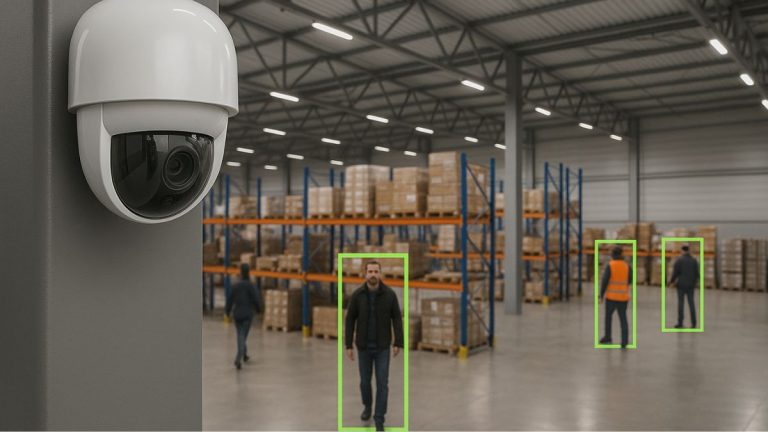
- Video analytics (AI): cameras with real-time processing that analyze motion, shape and behavioral patterns.
Operation may seem simple, but in industrial environments, sensors must be resistant to dust, humidity, light variations and electromagnetic noise. That is why it is key to choose sensors approved for industrial use, not adapted residential solutions.
Thermal, volumetric and microwave detectors: which one to choose?
There is no single ideal detector for all industries. What does exist is the need to assess the environment and risk before deciding.
PIR or thermal:
- They work by detecting human heat.
- They are economical and reliable in indoor spaces without sudden thermal variations.
- In poorly insulated buildings or with hot machinery, they can generate false alarms.
Microwave:
- Very useful in large surfaces and spaces with obstacles.
- They can pass through thin materials such as plastics or wood.
- They are more expensive and sensitive to electromagnetic interference.
Combined (PIR + microwave):
- They offer greater reliability by requiring double verification.
- Lower false alarm rate.
- Ideal for critical areas.
Video analytics with AI:
- Real-time analysis of the environment.
- Detection by shape, movement, pattern.
- They filter out irrelevant events and anticipate suspicious behavior.
At Alarmas Catalunya, when we work in complex industrial environments, we use customized combinations. In a warehouse with high ceilings and high heat, we place PIR sensors reinforced with AI cameras. In an outdoor area, we prefer industrial microwaves with early warning.
The key is that each technology has its strengths, but also its limitations.
Factors affecting reliability in industrial environments
A sensor that works perfectly in an office can fail constantly in an industrial building. Why? Because industrial environments have unique conditions that directly affect the reliability of these devices.
Among the most critical factors:
- Dust in suspension: may interfere with optical sensors or cover camera lenses.
- High or low temperatures: affect unprepared thermal and electronic sensors.
- Electromagnetic interference: caused by machinery, affecting microwave or wireless sensors.
- Vibrations and shocks: common in loading or production areas, they can decalibrate sensors if they are not protected.
- Variable illumination: automatic lights, reflections or shadows alter the perception of optical sensors.
For this reason, at Alarmas Catalunya we choose certified industrial equipment, with specific IP65 or higher protections, resistant materials, anti-humidity sealing and extended thermal tolerance.
And the most important thing: we design the installation adapted to each zone, not only to the general space.
Integration with intelligent systems: AI and video analytics
The great evolution in reliability has come with the integration of traditional sensors with video analytics systems based on artificial intelligence.
Instead of simply detecting movement, today we can interpret that movement. Is it a person? An animal? An object? Is it normal or suspicious?
This allows:
- Reduce false positives (very common in environments with dust, variable light or machinery).
- Activate alarms only when the movement pattern coincides with intrusion.
- Notifying the CRA with images in real time.
- Automate protocols (lights, door locking, security calls).
Alarmas Catalunya has been working with this type of solution for some time. In fact, in many installations we have eliminated obsolete perimeter sensors and replaced them with video-analytic cameras, which offer greater accuracy, less maintenance and faster detection.
Maintenance and calibration, the key to ensure reliability
A poorly calibrated sensor is the same as no sensor at all. And in industry, this is more common than it seems. That’s why maintenance is a critical part of the detection system.
We recommend:
- Quarterly or semiannual reviews depending on activity
- Cleaning of lenses and external housings
- Seasonal recalibration of detection ranges
- Simulation of events to verify response
- Preventive replacement of sensors due to wear and tear
In our experience, more than 40% of false alarms reported by companies are due to lack of maintenance or initial misconfiguration.
For this reason, at Alarmas Catalunya we always include after-sales services without permanence and periodic technical visits if the client wishes.
Common mistakes and how to avoid them
Over the years we have seen many mistakes repeated in industrial installations:
- Use of domestic sensors in aggressive environments
- Placing sensors too high or in blind corners
- Disregard nearby active machinery
- Combining bad technologies, generating interferences
- Failure to integrate sensors into a centralized system
Each of these errors reduces reliability and increases the risk of false alarms or worse: failure to detect a real intrusion.
That’s why we always recommend working with professionals who specialize in industrial safety. The technology is there, but if it is not installed correctly, it is useless.
Our experience providing real solutions in industrial buildings
Alarmas Catalunya has protected hundreds of industrial facilities: from logistics warehouses to manufacturing plants with unlit outdoor areas.
Our philosophy is clear:
- We do not sell standard boxes, we design solutions.
- We use AI, video analytics and certified industrial sensors.
- We do not require permanence.
- We provide quick response, professional installation and legal advice on compliance.
In many cases, we have replaced obsolete systems with more reliable and less invasive sensors, with excellent results.
Technology is important, but it is more important to understand the customer’s real environment and act accordingly.
In short… are they reliable? Summary and practical recommendations
Yes, motion detectors in industrial environments are reliable, provided that they:
- Are chosen according to the environment and type of activity.
- Are installed correctly by professionals
- Maintained and calibrated periodically
- Integrate with smarter systems (AI, cameras, CRA)
Ignoring any of these points can cause even the best sensor to fail. But properly implemented, these devices are a key tool for modern industrial safety.
At Alarmas Catalunya we are ready to help you choose, install and maintain the sensors you really need.