If you are considering installing an alarm system, you have probably come across terms such as “grade 2”, “grade 3” or “grade 4”. But what do they really mean?
Alarm security levels are a technical classification that indicates the level of protection offered by a system against intrusion or sabotage attempts. It is not a commercial whim or a fad: it is a European regulation that establishes objective criteria on what type of alarm is appropriate according to the type of property, its activity and its level of exposure to risk.
In other words, protecting a single-family house in a housing development is not the same as protecting a jewelry store or a logistics center. Each situation has its own requirements, and that is why there are grades.
From our experience at Alarmas Catalunya, we see it every day: many customers have installed systems that do not meet the grade required by law or by their insurance. The result? Risk of penalties, loss of coverage or, even worse, a false sense of security.
In this article I will explain what grade you need, why it is important to comply with it and how to make sure your system is up to par. Without unnecessary technicalities, but with the rigor that this subject demands.
Who regulates security grades and how are they classified?
The classification of security levels is not random. It is regulated by the European standard UNE-EN 50131, which establishes the technical requirements that alarm systems must meet according to the risk they face.
In Spain, these regulations are adopted by the Ministry of the Interior, through the Directorate General of Police, which establishes which grade is mandatory depending on the type of establishment. It also influences the requirements to be met by alarm receiving centers (ARCs) and approved security companies.
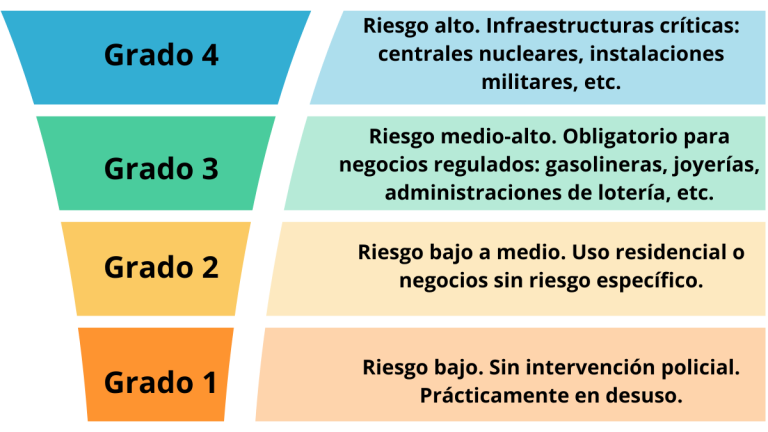
Safety grades range from 1 to 4:
- Grade 1: Low risk. No police intervention. Practically in disuse.
- Grade 2: Low to medium risk. Residential or business use without specific risk.
- Grade 3: Medium-high risk. Mandatory for regulated businesses: gas stations, jewelry stores, lottery administrations, etc.
- Grade 4: High risk. Critical infrastructures: nuclear power plants, military installations, etc.
Each grade requires certain components: detectors, wiring, anti-tampering, communication with ARC, encryption, etc. And it is not enough to “install for the sake of installing”: if your business requires grade 3 and you install grade 2, you are breaking the law.
For this reason, at Alarmas Catalunya we always advise our clients on the actual grade they need according to current regulations, not just what fits their budget.
Grade 1: What it is used for and why it is practically out of use.
Grade 1 is the most basic level of security. It applies to environments with no risk of intrusion, such as permanently inhabited dwellings or indoor spaces with active surveillance.
The truth is that today it is practically irrelevant. Neither insurers nor the police recognize grade 1 alarms as valid systems for responding to an incident. They do not connect to central monitoring stations and do not include anti-tampering systems. It is like having a “toy” alarm.
Some catalogs still offer such systems, but in our opinion, they do not provide any real advantage and only generate a false sense of protection.
If you are considering protecting any property that is not strictly private and of no strategic value, rule out grade 1 from the outset.
Grade 2: Most common for homes and small businesses.
Grade 2 is the most widespread in residential and commercial environments without specific legal requirements. It is valid for:
- Apartments and private homes
- Offices without high-value assets
- Retailers in low-risk areas
- Workshops and general stores
A grade 2 system already includes key functionalities:
- Indoor intrusion detection
- Communication with alarm receiving center (ARC)
- Protection against sabotage
- Video or audio verification
Most well-assembled domestic systems meet grade 2, but not all do by default. This is where many unapproved installers sell “cheap alarms” that do not actually meet the standard.
At Alarmas Catalunya we use video surveillance solutions with artificial intelligence that not only meet grade 2, but exceed your requirements by reducing the margin of error and increasing responsiveness. Many of our customers with small businesses have told us that, after switching providers, they discovered that their previous alarm was not even properly connected to an ARC.
Grade 3: Mandatory for medium-high risk businesses.
The grade 3 is no longer an option: it is a legal requirement. It applies to commercial premises handling cash or high value goods, such as:
- Jewelers
- Gas stations
- Bars with gaming machines
- Banks
- Lottery Administrations
- Tobacconists
- Armories
This grade requires the system to be approved, connected to a CRA 24/7, and to have mandatory event verification. In addition, it must have perimeter protection, early detection and valid technical reports to the police.
In Alarmas Catalunya we install grade 3 systems to measure, including:
- Cameras with video verification and analytics
- Frequency anti-inhibitors
- Protection of redundant communication lines
- Access controls with registration
We know that many companies try to avoid the cost of this degree, but doing so means being outside the law, and without the possibility of police intervention or coverage in case of theft.
Grade 4: Maximum security for critical infrastructures
Grade 4 is the highest level of security, reserved for critical facilities or those of special interest to the State. It is used in:
- Military infrastructures
- Power or nuclear plants
- Government data centers
- High surveillance installations
Grade 4 systems require:
- Full redundancy (communication, power supply, detection)
- Cryptographic protection of all signals
- Registration and traceability of all events
- Double verification and armed response
This grade is beyond the reach of most private users or standard companies. However, it is essential to know it because it marks the top in technical requirements, and serves as a reference to improve safety in demanding environments.
In some cases, industrial clients with critical installations have required grade 4 elements combined with grade 3 solutions. At Alarmas Catalunya we design hybrid solutions that combine high security with operational efficiency, without unnecessary oversizing.
5 common mistakes when choosing a security grade
In our experience, these are the most common mistakes made by companies and individuals:
- Buy on price and not on need
- Choosing an alarm that does not meet the grade required by law
- Relying on non-approved installers
- Assume that any camera alarm is already valid for grade 2 or 3.
- Failure to update the system when business activity changes
All of this can result in penalties, denial of insurance coverage or loss of valuable time in the event of an intrusion.
That is why at Alarmas Catalunya we insist on a previous, personalized and legally founded analysis before offering any solution.
How to choose the right grade for you?
At Alarmas Catalunya we work with all types of clients: from small workshops to logistics complexes or retail franchises. And if there is one thing we have learned, it is that there is no one-size-fits-all solution.
What we do is:
- Analyze the real risk of the property
- Evaluate the business activity and its applicable regulations.
- Review insurance requirements
- Design a solution that meets (and exceeds) the required grade.
- Integrate systems with video analytics based on artificial intelligence, eliminating obsolete sensors.
Thanks to this methodology, we prevent customers from overspending, but also from underspending. Security is not improvised. It is designed with criteria, technology and experience.
How to ensure your alarm meets the rating you need
Alarm security grades exist for a reason: to standardize protection according to the risk. Ignoring them, minimizing their importance or choosing the wrong grade can be very expensive.
Today, any professional installation must:
- Comply with the UNE-EN 50131 standard.
- Be approved by accredited companies.
- Be verified by a CRA
- Be adapted to the type of business and level of risk.
In Alarmas Catalunya we are clear that technology is only part of the system, the important thing is to use it strategically. Choosing the right level of security is the first step to protect not only a property, but also the peace of mind and continuity of your business.